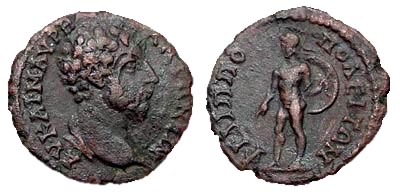
 Roman Provincials: Although technically speaking provincials are "Roman" they were minted for local use under supervision from the centralized mints. Although a Roman provincial coin may have been minted in any of a number of semi-autonomous locations, the most famous are the Greek. The Romans conquered Greece long before the birth of Christ but had no intention of obliterating their culture. In fact, they admired and copied the Greeks extensively in art, politics and coin design too. During what is referred to as the "Greek Imperial" era, various cities throughout Greece minted coins with the portraits of the incumbent Roman emperor but using Greek legends and locally meaningful designs on the reverses. The presence of Greek legends on a suspect coin is a dead giveaway that you have found a provincial. Another usual trait is that the coins tend to be rather thick. There are several provincial coins included in the database to show representative styling. However, if one turns up among yours you should consult an appropriate reference to get it attributed. One excellent resource is the Wildwinds.com online database. Roman provincial coinage, especially of non-Greek provenance, is much less studied than standard-issue Roman imperial issues so your chances of finding a rare or even previously undocumented coin are very good.
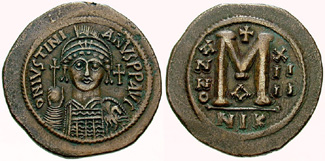 Byzantine: The Byzantine period is also technically Roman. At least Byzantines thought of themselves as "Roman" following the fall of Rome in 476 A.D. However, this was mostly so in terms of the dynastic imperial system which they inherited from the mainstream Romans. Culturally, they were more aligned with the Greeks. In about the year 498 the emperor Anastasius decided to institute a coinage reform which was to have a profound effect on currency from then on. Numismatically speaking, if not historically, this change marks the formal end of the Roman empire and opens the Byzantine. Chief among the aspects of the new coinage is the gradual abandonment of Latin in favor of Greek. Other stylistic clues are:
 • The adoption of rather massive copper coins (denominationally Folles) with large letters on the reverse.
• The declining use of portraits rendered in profile and instead from the front (facing us).
• The slow decline in the level of engraving technique. This eventually deteriorating to the point where human figures resemble "stickmen"
• The adoption of Trachys and Hyperpyra, oddly bowl-shaped coins.
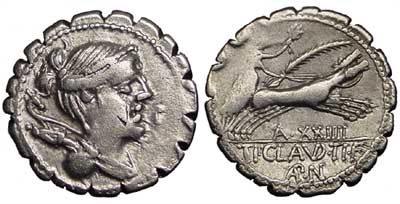 Republican: Roman coins through and through, just not of the Imperial period. Republican coinage immediately precedes that of the Imperial and the so-called "Imperatorial". They differ from Imperials in only one major aspect: the absence of living people portrayed on the obverses. Julius Caesar was the first to break rank with the long tradition by having some of the moneyers carve his portrait into their dies along with the systematic appropriation of every official role he could think of. The aftermath of this power-grabbing culminated in his famous murder on the Ides of March (March 15, 44 B.C.) by his own associates and throwing the empire into a major civil war which lasted for several years. The coins of this period are referred to as Imperatorial as the various would-be emperors jockeyed for the top position. Both Imperatorial and Republican coins are very unlikely to turn up among your uncleaned coins but you never know. The main problem is not their great age so much as the fact that most were minted in silver and gold. And as you should know by now, ancient coins of precious metals are hard to come by.
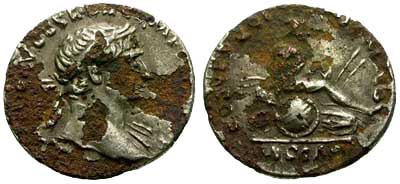 Fourrees: French for "stuffed", this next category are imitations created by ancient counterfeiters who would gather a certain number of real silver coins, melt them and then use a fraction of that same silver to plate over ordinary metal coins of their own making. Done repeatedly this would net the counterfeiter a tidy profit in silver. Some fourrees are indistinguishable from official issues because the quality of the engraving is so good. It had to be. If the copies were evident as such the counterfeiter could bet on a very unsavory future at the hands of Roman law. Telling a fourree is very easy if the plating has rusted through to expose the core. In many cases you may come across a coin which when cleaned up should be attributed as a Denarius and yet it is clearly not silver. That is most likely one of these fourrees. Fourrees are not worthless nor to be compared with modern forgeries. A modern forgery meant to deceive a collector will in all likelihood be of a solid metal to match the coin being copied. Ironically enough there are collectors who collect only fourrees and other anomalous coins for their own unique mysteries and challenges that they possess.
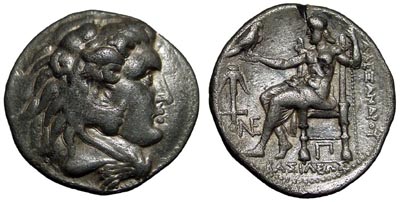 Greek: Greek coins appear with varying frequency in the supply of uncleaned coins from Europe. Naturally, the closer the digs are to Greece the better the likelihood that one may show up among more ordinary Romans. Unlike the silver coin shown here as an example, you are much more likely to find a bronze copper coin. Not to be confused with Greek provincials discussed above, pre-Roman Greek coins have no pictures of emperors. Rather, they will have traditional mythological figures and Greek writing (notice the characteristically vertical legend on the picture at left). Uncovering a Greek coin should always be a welcome sign if for no other reason than to contemplate their great age as many will date from just a few years B.C. down to the very birth of coins in about 650 B.C. Objects of great beauty, Greek coins are generally considered to have attained the highest level of artistry of any coins made, including even our own times. In the rare instance that a Greek coin cleans up to reveal good detail you can be sure that it will be a special find indeed.
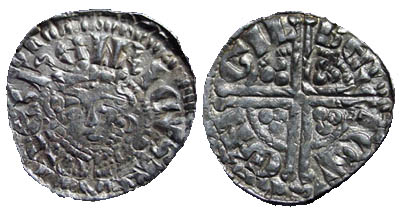 Medieval: Depending on where your coins were dug up, you may have a fair chance at discovering a medieval coin under the dirt. The medieval period in numismatics is extensive and covers coins minted in what was formerly the western Roman empire immediately after its downfall until more or less the advent of stamped coins over a thousand years later. While there are many designs there are some common elements that will help you identify a coin as medieval. First and foremost medieval coins tend to be of poor artistry with crowded design elements. Although a fair percentage will have the likeness of a ruler you may expect it to be crude and abstracted. Where there is lettering it will be difficult to decipher or downright unintelligible. The coins themselves tend to be fairly flat and susceptible to bends and clipping. Due to the nature of countless independent fiefdoms and their issuing authorities during the feudal age, fully attributing an obscure medieval coin can be among the most challenging of numismatic tasks.
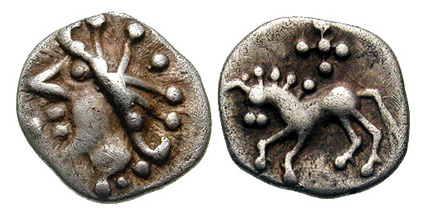 Celtic: The Celts were a culture contemporary to the Romans and one of their greatest adversaries. Like the barbarians to the north, the Celts were the unassimilated and unconquered tribes to the west. As they were slowly driven out of Gaul they were pushed out into Britain, Ireland and parts of Spain but were never fully conquered. Unlike the barbarians, however, the various Celtic tribes were not pseudo-prehistoric nomads. Among other things they pursued trade and their economic models needed currency to facilitate it. The character of their coins combines familiar elements of Roman coins with a distinct flavor all their own. Quintessentially Celtic is the use of mythological animals in disjointed, surrealistic forms. They also used a lot of raised dots, lines and circles the symbolism of which is not conclusively known. Celtic coins are highly sought after by collectors for their haunting artistry and enigmatic symbolism.
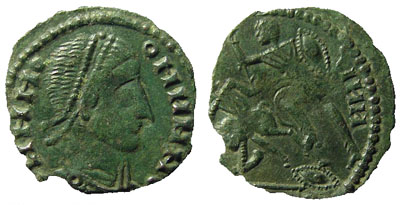 Barbarous: Associated with the Celts, so-called barbarous/barbaric coinage directly imitates official Roman coins. These imitations were not meant as counterfeits but rather to facilitate local trade where official coins were scarce. There is evidence that the two co-mingled with official coins without arousing much concern by Roman authorities. In some cases they may have circulated completely outside of the formal Roman borders. These unassimilated peoples may have found the benefit of using coins to facilitate trade but for one reason or another did not mint coins using themes unique to them. Barbarians were illiterate and to them the writing on coins must have looked like flowery ornaments that made no sense but were still somehow an integral part of a coin's design. For this reason these curiousities always stand out for their gibberish writing (sometimes with hilarious letter sequences!). Even when the writing is not clear the style is decidedly more crude in execution than the work of the classically trained mint workers. An important exception would be Visigothic coinage and the coins of other similar tribes whose imitative artistry often equalled or even surpassed that of the best Roman engravers. It will not be discussed separately because their output began appearing in the very late- and post-Roman period ...and mostly in gold at that. Barbaric coins don't show up very often and, unfortunately, are not worth very much when they do. For being so interesting it's a bit of a wonder that they have not developed a strong interest in the collecting community.
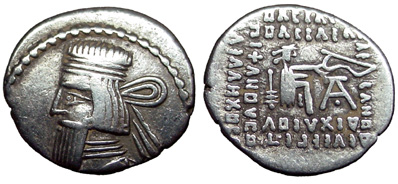 Parthian: To be honest, the likelihood of finding a parthian (or persian) coin is remote. However, as their coins mingled with and within Roman circles the possibility should not be discounted entirely. Their fascinating designs include the portraits of the many rulers who gave Roman emperors countless headaches throughout their long rivalry. Also to be noted is their peculiar writing style and the squarish arranging of the legends. If you should be lucky enough to find one you should consult a specialist in the area to get more information as their series is well documented. One excellent internet resource is the web site at http://www.parthia.com
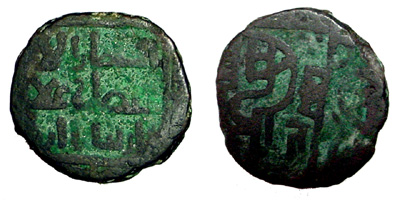 Islamic: Parthian/Persian coins slowly blended into Islamic as the various oriental cultures converted to Islam. One of the primary design changes was the abolition of the representation of people or animals. That left ornamentation and writing as the sole design elements in Islamic coins. Unless you have an understanding of Arab you're bound to be lost on what will appear to be coins that look alike to each other but may have actually been minted many hundreds of years apart. Although infrequent, Islamic coins do turn up every so often, especially for coins excavated in the middle east.
 Modern: Thankfully, it is a fairly rare event to find modern coins in groups of uncleaned coins. Telling ancient from modern is made quite easy because ever since the 1600's coins have been made from stamped blanks which are perfectly round. As you can see from this barely recognizable wheat penny from 1936 (found in Europe), modern coins usually fare no better the ravages of time than their much older cousins.
 Still at a loss for what you have found? Many things have been known to turn up in groups of uncleaned Roman coins... and some haven't been coins at all. Reports of various types of tokens, medals, buckles, puzzling metal objects, etc. are commonly unearthed. The chances of finding something unusual is just that: unusual but not impossible!