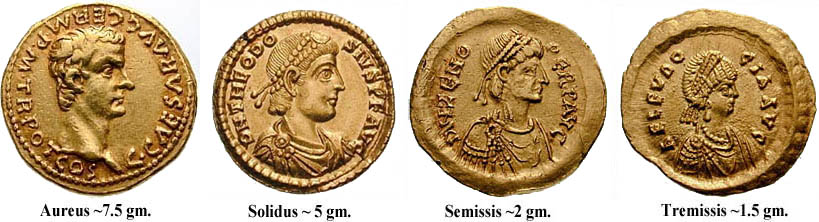
Gold Roman coins tend to be found in good condition and are generally easy to identify unless heavily worn. Roman gold coinage falls into two distinct periods, the age of the Aureus and that of the Solidus. The break came following the reform of Diocletian in about the year 293 A.D. Before that time and going back several centuries Aureii remained relatively unchanged in precious metal content and received the highest degree of craftsmanship in their design and execution. Samples can be obtained today that look as though they were just minted. Of course, they tend to be very expensive due to their rarity.
The Diocletian coin reform launched a gold coin a bit smaller in weight but still of very high purity. In addition, two smaller denominations, the Tremissis and the Semissis, began appearing alongside the solidus. These were to be considered fractional Solidi and didn't circulate widely until late in the Roman age. Most Solidi, in fact, were never meant as pay for civic projects or the military. By the fourth century Roman soldiers saw gold coins only upon the accession of a new emperor or on other rather rare major events. Instead, they were increasingly used to pay off aggressive barbarian tribes. The general public had to make do with non-precious metal coins for the most part. Much as today.