Welcome to the fascinating adventure of uncleaned ancient coins! We hope you will find this hobby as addictive and educational as thousands of others. With this kit you now have in your hands everything needed to turn an ancient piece of metal into a unique artifact of historical value worthy of being treasured for generations to come.
These handmade coins have been recently recovered from the ground by metal detectorists throughout Europe, Asia Minor and North Africa and are in the same condition as when retrieved. You will be the first to have the opportunity to see what’s beneath the dirt of the ages. With the help of this booklet and the enclosed CD you will also be able to identify under whose reign the coin was minted and, in many cases, be able to tell a variety of other interesting information regarding the coin.
Most of the coins you have will date from the 4th century A.D. and be of Roman provenance. This was a period of extraordinary change in the Western world. Christianity was quickly reaching the farthest corners of Europe and replacing old pagan rituals as the dominating religion. The Roman economy faltered under the strain of continued invasions by Barbarians. To remedy this situation, the various emperors of this time period resorted to issuing large amounts of bronze coinage. The coins were paid to citizens of all walks of Roman life from the nobility down to the lowest paid peasants. Gold and silver coinage was produced as well but these played a more important role in the army and within the government. This left the copper coins for the average man who may have bought with it the family’s bread, oil, clothes and so on. Just as now, the copper coins carried little value individually and thus many were needed to make purchases.
For this reason they were easily lost and attempts to recover them were not strenuous.
Over time, the coins became embedded in the dirt and were lost forever. Forever, that is, until modern times. Mainly through the efforts of numberless aficionados with metal detectors these coins are now being unearthed. The detectorists are for the most part seeking other antiquities and either discard the coins or pile them up until they have enough that someone will buy them in bulk. These in turn eventually find their way into coin dealers who sell what they do not want for themselves. Because it often takes a long time to clean them it is not cost efficient for them to undertake this task even when a few of the coins turn out to be valuable rarities.
The chance that some of the coins can be worth hundreds, or even thousands of dollars adds a “treasure hunting” aspect to the hobby that draws many new people each year. Even while most turn out to be rather common examples that when cleaned fetch little more than the initial price paid the expectation that builds on the “what if” factor is enough to make many people continue to buy more much the same way as lotto tickets. However, unlike the lotto, the coins you clean which turn out to be of little monetary value are almost always of great historical and educational value nonetheless. You may well find it hard to get rid of the same coin that took you many hours to clean.
To many collectors cleaning is half the fun (or more!). There are many ways to clean these coins. In time you will find a preferred method of your own as most try slightly different variations and some zealously guard their secret coin cleaning recipes. Unfortunately, it takes a rather long time and a lot of effort to do a great cleaning job. After being under the ground for over 1,500 years these coins do not like to shed the dirt of the ages so easily. Rushing the process by taking shortcuts is only bound to disappoint you with inferior results and/or damaged coins.
The traditional way of cleaning ancient coins has been to soak them in olive oil for a long time. Sometimes weeks or even months. Every so often the coins are taken out and they’re vigorously scrubbed with a toothbrush and dish detergent. In time, the dirt layers soften and become muddy and melt away under the scrubbing. Little by little the coin is revealed until entirely clean.
In more recent times additional methods have proven equally successful and, thankfully, have involved less time to achieve the same results. For one, olive oil has no magical advantages over other types of oil. The main difference seems to be the viscosity of the oil. A lighter weight oil will penetrate dirt faster but not do as good a job at softening it. A heavy oil given enough time turns the hardiest crust to mud but the length required will try the most patient of collectors.
And oil is only one of the ways to clean dirty coins. Many now substitute oil with water to accomplish the same thing. Some coins are found in a state clean enough that they don’t really need a soak of any kind. These often have little unsightly hardened deposits on the coin’s surface that can be picked at carefully using a dental pick or an Xacto-type scalpel. Magnification and great care must be taken to avoid scratching the coin since this happens much too easily, often ruining the coin. Some coins have even, light dirt coats which can be removed by adding a layer of Elmer’s glue and then peeling it off and repeating the process. While this method works quickly it is labor intensive, tedious and not for every coin. Specifically not recommended are those coins which have shiny patinas. The glue will remove some of the patina and turn the shiny surface matte and sometimes pitted.
A coin’s patina is considered visually attractive and to be protected as much as possible. The patina is simply a thin layer of oxides that has formed on the surface. It takes various hues of green and sometimes a shiny black or red. If you receive a coin which has a patina do not try to remove it during cleaning. Removing it often exposes a pitted, awful looking core of a coin. The patina, in fact, has become a protective cast to the coin and prevented it from deteriorating further.
Unfortunately, it is often the case that in the soil the coin has little chance to form an attractive patina. Very frequently uncleaned coins will have stubborn dirt that does not seem to be affected much by the cleaning and soaking cycles or the other methods already discussed. For these coins there is an alternative which many use indiscriminately if only because it is very effective at removing dirt in a short period of time. This is the process of electrolysis.
There are several methods which are decidedly not recommended. The use of acids, polishing agents and wire brushes will almost always damage your coin quickly. For bronze coins acids are especially harmful and will make the surface of the coin pitted long before the acid eats away at the dirt. Most polishing compounds use abrasives that will gouge the metal and when they don’t they use chemicals which invariably always are too strong for the ancient copper alloys used in the coins. And the use of wire brushes, steel wool or similar will make short work of both ancient dirt and ancient coins alike.
In the end it bears repeating that the more time you allow the cleaning of any one coin the more likely you will be rewarded with a coin worthy of being displayed.
What to expect
Although the vast majority of the coins will turn out to be from the 4th century, and recovered from what was then the Roman empire, occasionally you may find coins from other periods such as earlier/later Roman, Byzantine, Greek, Judaean, Medieval and others. Not all the coins you have will clean up nicely. Many in fact will, once cleaned, turn out to be so worn or damaged that they’re unable to be identified. Because the coins are covered in the dirt they were found in means you may end up with a dud or a great rarity. It’s all part of the fun and the only thing you can be sure of is that under the dirt will be some ancient person’s lost money. We have, however, stacked the odds in your favor by deliberately removing coins which we find to be clearly defective. These include coins that are broken, holed or badly misshappen.
Although you will be the first in thousands of years to uncover these particular coins, over the course of centuries, hundreds of thousands of similar coins have already been cleaned. Statistically, therefore, we can tell you that you can expect a good part of your lot to contain one or more of the following:
 Fel Temp Reparatio Gloria Exercitus Vota issues Victoriae Securitas Reipublicae Gloria Romanorum Camp Gates
These are just the reverses that turn up most frequently in uncleaned coins but many more patiently await your cleaning. You will likely come across some 3rd century coins which often have portraits that bear a radiate crown. You may see a few 5th century Roman coins, often of very small diameter and challenging to properly attribute.
What you should not expect, however, are gold coins. Gold does not tarnish or rust in the dirt so when the few that are in the ground are dug up they are immediately spotted and removed from the regular coins. In the unlikely event that they are covered in thick dirt they will be spotted as soon as the batch is hosed down before being sold off to dealers. Unscrupulous ancient coin dealers sometimes claim that gold is found in their coin batches but these are nothing but shined-up brass coins. These dealers prey on those new to the hobby and exploit their lack of knowledge while often passing off inferior stock.
What can be said for gold also goes for silver coins although to a lesser extent. Silver coins are found perhaps once in every few hundred uncleaned coins. A dealer may include a few low value ones intentionally to generate some interest. Either way, think of these as being “let through” more so than “slipped by”. You will be able to tell you have a genuinely unsearched silver coin if it is covered completely in dirt before being cleaned.
Cleaning tips
In order to determine which is the most effective approach for a given coin first you should determine what type it is. Generally speaking, your uncleaned ancient coins fall under three types:
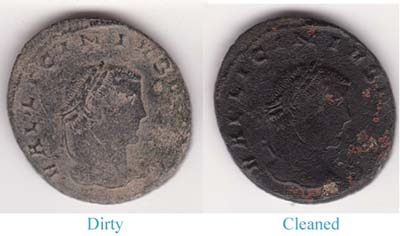 The first type is a lightly
soiled coin which is often fully attributable even when “dirty”. This type of
coin most likely came from a hoard along with many other coins. Because they
were buried in clay pots or similar containers these coins were largely
shielded from the ground itself. Rainwater, dust and the detritus from the
vicinity accumulated on them over the ages and this often were ideal conditions
for the coins to develop a patina along with a light coat of dirt.
The first type is a lightly
soiled coin which is often fully attributable even when “dirty”. This type of
coin most likely came from a hoard along with many other coins. Because they
were buried in clay pots or similar containers these coins were largely
shielded from the ground itself. Rainwater, dust and the detritus from the
vicinity accumulated on them over the ages and this often were ideal conditions
for the coins to develop a patina along with a light coat of dirt.
Hoard coins should be handled with relative care and gentle cleaning procedures should be used. Attempt to clean them first with nothing but water and brushing. Failing this, soak them in light mineral oil for a week or two, scrub it and see if any progress is made and the process can be repeated.
It’s often the case that hoard coins come in an essentially clean state with just occasional light deposits on them. Many collectors prefer to leave some of this dirt on the fields as it gives a pleasing "ancient" look and has the added benefit of increasing contrast. The increased contrast helps bring out faint lettering and portrait details.
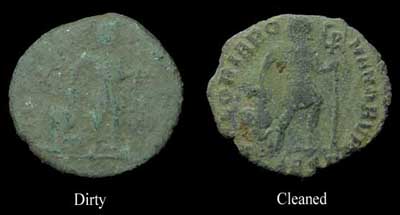 Next come the typical uncleaned coins.
These types often have some discernible features showing through a thicker
layer of dirt than hoard coins. Unlike hoard coins however, these were found singly or
in groups in the ground in which they remained buried for hundred or thousands
of years. Because they were in direct contact with the soil the coin’s metal
reacted with its surroundings in unpredictable ways. Although this type of coin
sometimes shows a patina, often there is no even,
attractive metal oxide layer underneath.
Next come the typical uncleaned coins.
These types often have some discernible features showing through a thicker
layer of dirt than hoard coins. Unlike hoard coins however, these were found singly or
in groups in the ground in which they remained buried for hundred or thousands
of years. Because they were in direct contact with the soil the coin’s metal
reacted with its surroundings in unpredictable ways. Although this type of coin
sometimes shows a patina, often there is no even,
attractive metal oxide layer underneath.
Because of the unpredictable nature of the average uncleaned coin, you will need to assess its condition and determine what course to follow in cleaning it. As with the hoard coins, it’s best to try the milder cleaning techniques first to see whether these are effective. If soaking and scrubbing fail to dislodge the dirt you may have no option but to use more invasive means. It is important to realize that patience is the key factor to success in restoring these antiquities, rushing the job in desperation will disappoint you in the long run.
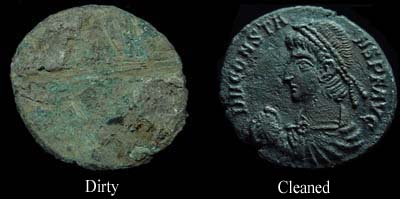 Finally we have those coins
which are so dirty that the dirt has become a cocoon. While attempting an
initial soaking in water is recommended on the off chance that it can dissolve
some of the dirt, it is much more often the case that these coins will
respond poorly to soakings of any type.
Finally we have those coins
which are so dirty that the dirt has become a cocoon. While attempting an
initial soaking in water is recommended on the off chance that it can dissolve
some of the dirt, it is much more often the case that these coins will
respond poorly to soakings of any type.
Electrolysis or extended periods of soaking in oil are the most likely routes of dealing with the crust. While soaking and brushing and electrolysis are the main methods for cleaning coins these are by no means the only ones. Some hobbyists have reported success by freezing the coins then throwing them into boiling water. The principle behind this strategy is that as metal expands during “thermal shock” the dirt is unable to hang on to the coin’s surface. While this is an interesting approach you should expect different levels of success depending on the type of dirt that is found on the coin to be cleaned.
For those coins which have persistent thin layers of dirt which scrubbing fails to remove you may try treating by means of adhesive. Simply apply some glue such as Elmer’s to form an even coat and let dry for a few minutes then peel it off. You will notice that the dried glue has come off with some of the dirt and this process can be repeated several times. The main disadvantage of using this method is that it often damages the patina, if there is one, giving it a “matte”, low-contrast look. Experimenting perhaps with a lower grade coin first may be advisable to learn how this process works and where it may most efficiently be used. Others have resorted to using rock tumblers or jewelry cleaners. While these are worth considering, they take special care and equipment and, at best, seldom yield better results than the more traditional means.