Just about any ancient Roman coin you are bound to find will have the name of the emperor (or that of his relative) written out on the portrait side of the coin. The easiest way to identify your coin is by using the clues provided by this lettering. You do not have to be able to read all of the letters but the more that you are able to pick out the more focused your search will become. When it comes to Roman coins, attributing your find successfully is more often than not an elimination process that leaves only one, or few, possible rulers to whom it can be attributed.
Unfortunately, you will find that many of the coins that you clean will have all or parts of the lettering worn off or unreadable for any number of reasons. While it is usually possible to ID a coin with no lettering remaining it undoubtedly becomes a more challenging task. Your best bet is to use the clues provided by the remaining details. To begin, let's analyze a typical coin of the type you are likely to find:
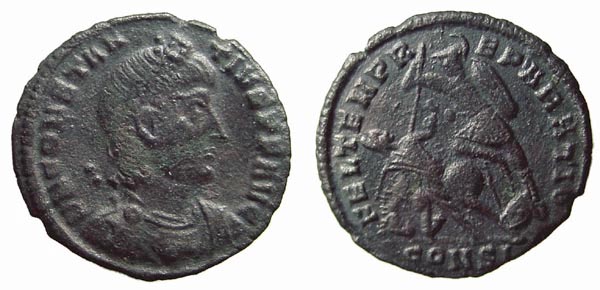
In this case, our coin has distinct lettering on both sides but the individual letters are a bit blurry. For certain on the "heads" side of the coin we can tell for sure that on one side it looks like STAN and by his forehead TIV. When we enter the string STANTIV into the database's search engine four entries are returned; all of which seem to be variations of CONSTANTIVS. Suddenly, we've narrowed down the possibilities from about 200 to just four. In hindsight, the rest of the lettering to the left side should become more readable now that we're "forced" to see a CON before the STAN.
But this is not acceptable. We would not want to look through literally hundreds of entries on the database for a match under all four rulers. How can we narrow down the search even more? At this point we should look to the "tails" side of the coin for additional clues.
It should be immediately obvious in this case that there seems to be a struggle between two people, the luckless one on the bottom receiving a fatal blow with a spear. Reading again the letters the clearest ones seem to be the second through fifth bearing out ELTE. Returning again to the search engine, it seems that this letter sequence happens for the coins of only six rulers. Of those six only two were hits in the previous search, Constantius II and Constantius Gallus. So we have now narrowed it down to just these two. If we were to search within each page for the ELTE sequence we would quickly see that both emperors have an affinity for the very same reverse of type FELTEMPRAPARATIO which are indistinguishable in design from one to the other. So is this as far as we can go? No, the portraits now provide us with important distinguishing features. Notice that all of the Fel Temps of Constantius Gallus have his portrait with a bare head while those of Constantius II have him with a pearled headband. The lack of this headband, called a diadem, is symbolic of a ruler who had not yet become emperor but was merely a prince. This is also borne out under careful examination of the writing which for Gallus ends in NOBC while for the emperor Constantius II they end in a more explicit AVG for Augustus, the formal title of an emperor.
We have therefore determined that this coin is a Fel Temp Reparatio of Constantius II. However, if we wanted to we could go even further thanks to the last bit of information which is clear to us. The lettering of the exergue. The exergue is that portion of the reverse side of a coin directly at its six o'clock and usually under a line. In this area go various mint marks similar to the solitary letters we find in our modern age pocket change which tell us where the coin was made. In the case of Roman coins, exergual markings often became very complex and difficult to understand. They were not written for the benefit of the public which used them but rather for administrative bodies which needed to track the flow and quality of the coins from all over an enormous empire. In the case of this coin we are fortunate to be able to read very clearly CONS with another partial letter that cannot be made out. Browsing over the list of dozens of different coins for Constantius II we are overwhelmed to find many coins which not only come from the mint of Constantinopolis but also just so happen to be Fel Temp Reparatios as well! Looking a little closer, however, we can see subtle differences in the mint marks and/or legends (the lettering we decoded). Because numismatic historians have carefully studied each minor variation, they have classified sometimes hundreds of varieties for a single ruler with a single type of reverse. Although initially daunting, it should become trivial to find the combination that matches closest to the coin you have to get the correct attribution. However, today we're lucky and we see that the entry for RIC 119 matches perfectly. The fragmentary letter after CONS, it turns out, is an officina. This is an internal department within the actual mint building equivalent to saying "...And this coin came from the 5th floor of our mint facility".
Because of this great variety of subtle differences, you will likely come across coins which do not have an exact match on the image database. Don't despair if this happens, there are thousands of coins and no image database is likely to have every combination. It is also a little "special" to get a coin not matching entirely as this means it must not be very common. What should be most important in your attribution quest should be to match your coin to the correct emperor. Getting the final attribution as to exact catalog number (if not found here or on another database) will require access to that reference book. In the case of RIC (the Roman coin reference "bible") the entire series runs into about a dozen books costing over $1,000!
It is our hope that this primer will have given you the critical first few steps on how to begin with your first coins once you have cleaned them. With practice it will only take you a few glimpses of a coin to know whose emperor it belongs to!
You’ve cleaned the coin. Now what? The next step is to get some information from the coin in order to attribute it against a reference source. The most gratifying step may well be the deciphering of part or all of the legend on the obverse (heads) or reverse (tails) of the coin and checking out who could have minted it. While reverses were shared by many different emperors the obverse should in most cases belong to only one ancient personality. Even though a coin whose legend is no longer readable or whose legible letters are too few to make out a name may still be properly ID’d it will significantly more difficult and sometimes not possible.
So start by trying to read as many of the letters as possible. Keep in mind that the coins will have the emperor’s (or empress) name encoded within the lettering. For Roman imperial coins this coding is easily learned and recognized. The coin engravers (called celators) were giv en the job of putting in as much information on a coin about the person being depicted as possible. In order to accomplish this task they eliminated spacing between words and abbreviated as much as possible. Because the emperor wished to let everyone know of his impressive titles the format of most coins consists of several acronyms that stood for various imperial titles that the emperor may have been granted. Fortunately, the names of the emperors were nearly always included on the coins being minted. Included in the CD are several tutorial that will help you become familiar with your coins at a glance. Over the course of several centuries Roman coins remained largely unchanged in their designs. Although near the end of the empire engraving artistry had deteriorated considerably the coins themselves remained characteristically "Roman" and easily differentiated from the coinage of other cultures. The Romans were the first to use the Latin alphabet and place a systematic emphasis on lifelike portraiture of the reigning emperor well into the third century. Upon inspection of your first cleaned couns you should begin to notice these consistencies and as you gain familiarity with their designs you will find it increasingly easier to identify, date and attribute your restored coins.
The obverse or "heads" of the coin will carry the name of the emperor. For most late Roman bronze coins the format was somewhat standardized and read DN(emperor)PFAVG. As mentioned before, there won't be any spacing to help you read what will often be quite faint letters and, to make it more challenging, the entire legend may be broken up depending on the coin's design. Therefore, simply look for whatever is in between the DN and PFAVG or what remains of the legend to get the emperor for your coin.
If you can make out the name of the emperor proceed to the reverse. The reverses carry many motifsof an often military or religious nature. Unlike the obverse, reverse legends are more likely to carry complete words. Think of them as ancient "bumper stickers" with a phrase relating to the design. With time, you will notice that you hardly have to read the inscriptions in order to recognize designs particular to one or just a few emperors out of the many that struck coins in their name.
At this point you may want to proceed to opening the image database. From the main page, just choose a display mode. It is recommended you try the "No Frames" option first as this will free up more of the screen. However, smaller screen resolutions may show the various emperors all "jumbled up" and you have to resort to the framed mode. You should now see a listing of the most popular rulers who issued coins during the Roman era. Locate the emperor and find the likely denomination for your coin. Since more than likely this will be a bronze you should look for the entries that begin with “AE” which is the numismatic shorthand for non-precious metals. For the purpose of our activities, we will most often look for small bronze coins which are AE2, 3 and 4. The numbers roughly indicate the size of the coin with an AE2 being about the size of a quarter, AE3’s about the size of a penny and AE4’s being anything smaller than about the size of a dime.
Narrowing down your search you will then see several different coins offered under each denomination. These are organized by RIC catalog number which is the most authoritative reference source available. You need only look for the reverse type that most closely resembles the reverse of the coin you’re looking for. Clicking on a likely entry will bring up the picture to which it’s attributed. If the two coins match then you’ve attributed the coin and can refer to it by the “catalog number” listed for that entry; ie. RIC 212 or BMC 410 and so on. Most entries have more than one catalog number. This is an intended redundancy which helps in cross-referencing.
If you are unable to determine the emperor from the obverse legend your task will be more difficult but not impossible. The portraits on the coins are unique and often of excellent quality. The older the coin, actually, the more likely that the portrait resembled the living person. In fact, many emperors whose reign was long enough literally show their aging on their coins. With the Christianization of the empire starting in the 4th century less and less emphasis was given to capturing the likeness of the ruler on the coins as this was considered blasphemous or unimportant. By the mid-4th century these portraits became more or less interchangeable with one another and, later in the Byzantine empire, the portraits looked little more refined than the drawings of a child!