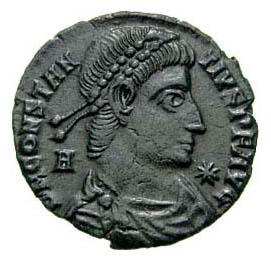
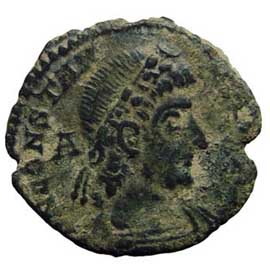
These are some of the more common terms you will come across as a collector of ancient coins:
AE Abbreviation for Aeratus, Latin for copper. In numismatics, the term is used to describe a coin whose given name is unknown or whose denomination is unclear due to poor preservation. Generally speaking, for Roman coins there exist four categories:
AE1: Copper coins (to include bronze, billon, orichalcum, etc.) of size over approximately 27mm in diameter.
AE2: Coins ranging in size from ~22mm to ~27mm in diameter.
AE3: Coins ranging in size from ~16mm to ~21mm in diameter.
AE4: Coins smaller than about 16mm in diameter.
Additionally, there are weight considerations to be considered so that, for example, an AE3 of unusually high or low weight may be bumped up or down accordingly. Traditionally, most numismatists just use the terms based on size alone. Roman provincial coins do not generally use the same terminology. A provincial will be described as AE followed by a number equal to its average diameter.
Antoninianus Modern-given name to the coin denomination created by Caracalla and popularized by Gordian III in step with the phasing out of the Denarius. Initially, this coin held the equivalent of 80% of the silver content of two Denarii. However, within a few years the silver content petered out to a measly 2%. It is generally thought that even this low amount of silver remaining was unintentional. The mint workers simply did not know how to refine the silver out any further from the alloy mix they were working with. When Antoniniani were so debased that they no longer looked silver a process was found to give them a pure silver coating. This thin silvering actually carried a substantial part of the total silver content of the coin.
AR Abbreviation for Argentum, Latin for silver. Normally the letters "AR" will precede denominations given for coins that were normally struck in silver. For example, you may find a coin described as an AR Denarius. Once familiar with the fact that all Denarii should be silver the pairing may seem redundant. However someone may refer to a fourree as an "AE Denarius" to point out its true metallic character.
Argenteus A short-lived silver denomination equivalent in weight and fineness to the Denarius created under Diocletian's currency reform of 293-294. Although it was essentially a restored Denarius it had a face value of 100 Denarii. The Argenteus never caught on as a commercial institution. They were minted in limited quantities and their high official cost made them inadequate for the marketplace.
As A copper coin of relatively low value worth half a Dupondius. The As was discontinued in the third century.
Attribution The act of cross-referencing a coin to a published numismatic reference work. The vast catalogs of the Roman Imperial Coinage series (RIC) are the primary catalog citations used in this database. Other citations used include Cohen, Sear, Van Meter, Normanby and others.
AU or AV Abbreviation for Aurum, the Latin word for gold. Used similarly as with AR (see above)
Aureus The standard gold coin of the Roman empire since Republican times until the reform of Diocletian. An Aureus was made from 22 karat gold and weighed between 7 and 8.5 grams during its long tenure. A typical soldier earned one Aureus per month.
Caduceus A winged staff with intertwined snakes. Originally of Babylonian and then Greek significance, the staff and snakes were associated with healing priests. During Roman times it became symbolic of peace and neutrality.
Celator A coin die engraver.
Cornucopia Portable horns used to store food or other items. Symbolically, the cornucopia is shown as a symbol of abundance and prosperity.
Cuirass A type of armored breastplate.
Denarius The standard silver coin of the Roman empire. Weighing about 4 grams, the Denarius suffered a slow but gradual debasing and weight loss following the coin reform of Nero. The emperor Gordian III struck the last of the Denarii and what few remained in circulation were pulled soon after. Within another couple of decades Romans would never again see much in the way of silver coins for commerce. After this period new Denarii would leave the mint a percent or two lower in fineness with each new emperor until no more than half of the coin's weight was actually silver. At about that time it ceased production.
Denticles The little dots that normally surround the coin. These delineated the border of the coin and helped to discourage clipping.
Diadem A head ornament used by emperors to depict their absolute power. Symbolically, diadems (as opposed to laurels) represent authority of the emperor who has seized this power due to his personal achievements and military might and, eventually, because of a divine mandate. Diadems come most frequently adorned with pearls but also rosettes or combined with other elements.
Dupondius A bronze or brass coin worth half a Sestertius and two Asses. The Dupondius features the emperor with a radiate crown as in Antoniniani.
Exergue The bottom area of the reverse side of a coin. Usually delineated, this space was sometimes used prior to the advent of mintmarks to include especially wordy legends. Once mintmarks became common in the mid-3rd century they quickly settled into this "reserved" area although the reverse fields continued to be used as well for this purpose. In rare cases, the obverse also carries some exergual material.
Fields The flat, indented parts of the coin.
Follis Coin denomination introduced by Diocletian. Minted in large quantities, the Follis became the backbone of the new coinage. It contained approximately 3% silver and was tariffed at 25 Denarii. Folles diminished in importance after Diocletian's abdication and were quickly reduced in size and what little silver they had evaporated. Over the course of a generation Folles had become ordinary AE3's.
Flan The coin itself, as in the blank it was made from. Coins will sometimes be referred to as having been struck on an irregular flan or a large flan or some other adjective.
Labarum An early Christian sign, the labarum was a banner with the Greek letters Chi and Rho superimposed over each other. The symbol became a Christogram to signify the bearer was a follower of Christ. Constantine The Great was the first emperor to use the labarum and the Chi-Rho in coins.
Lituus A wand-like religious instrument used in ritualistic ceremonies.
Obverse The front or "heads" of a coin. Almost every Roman coin will have the portrait of the current ruler, a family member or the personification of a Roman god. In rare instances some coins may seem to have two obverses. In those cases the true obverse will be the one whose portrait represents the living or senior ruler.
Patina Metal oxides forming on the surface of a coin, particularly copper-based ones. Patinas are not only considered attractive but also serve to protect the rest of the coin from further deterioration. Patinas come in many different colors depending on the environment they were found in. A patina is not to be confused with soil residues that are sometimes left on a coin for aesthetic reasons such as to enhance its contrast.
Quinarius A rare coin denomination worth half an Aureus. They were minted in very limited quantities in the late 200's.
Reverse The back or "tails" of a coin. The opposite of obverse. The reverse carries any of a number of messages that the mint has designed on behalf of the emperor on the obverse. In some cases, particularly late in the Roman empire, reverses were shared for different emperors. In general, the vast majority of reverses honor a traditional Roman god or depict some triumphant event performed by the emperor.
RIC Acronym for the Roman Imperial Coinage series of reference books. This series is widely regarded as the definitive reference set for Roman coins. Begun in 1923, it grew to encompass ten volumes that were not finished until 1994 and is still undergoing periodic revisions to this day.
Scepter A staff. On Roman coinage, the staff is symbolic of imperial power.
Semissis A rare gold coin denomination worth half of a solidus. Late fourth century through Byzantine period.
Sestertius A Roman coin made from orichalcum, a copper and zinc ore and worth a quarter of a Denarius and two Dupondii. It weighed approximately 26 grams. The Sestertius proved to be a popular coin during the first and second centuries. Because of the large coin size coin engravers were able to achieve their highest artistry on this coin denomination. In fact, after the declining use of the coin in the third century Sestertii were the preferred vehicle for producing presentation medallions on special occasions.
Siliqua A silver denomination used in the post-Tetriarchal period of the empire and beyond into the Byzantine. A siliqua weighed a little over two grams but was tariffed significantly higher than the discontinued Denarius. In fact, siliquae were rather rare currency and never circulated widely due to their scarcity.
Simpulum A ladle-like instrument used in religious ceremonies.
Solidus The standard gold coin of the post-Tetriarchal Roman empire. Solidi weighed roughly 4.5 grams and were worth 24 siliquae. They were always minted in high purity even during troubled times. The Solidus remained in use from the early 300's through the fall of the Roman empire and for the entire length of the Byzantine empire.
Standards Roman battle insignia. Standards took the form of ornamented poles and were carried into battle. Far from just morale boosters, the various elements in their design could be changed conitnously during the course of the battle as a signalling device.
Tremissis A Roman gold coin weighing approximately 1.5 grams and equivalent to a third of a Solidus. In use from the 4th century onwards.